
 | ||||||
What's Rural?
Donna j Mann
The rural landscape is changing in terms of seeing busy rural churches on the corner of many farm concessions or on a village side street. This gives the local motorist a different view when traveling down a country road or through sparsely populated areas. Justice questions about good stewardship, part time ministry, lack of musicians and active lay people have initiated some denominations to explore amalgamation, realignment or to cluster pastoral charges together to offer people a worship experience in a shared environment.
Some people meet this movement with a new sense of hope, while others turn their heads with a critical eye. Sometimes any of the above tried and proven solutions have not been enough and choices become even more limited. If a congregation decides to close their building, some parishioners turn off the light, shut the door and walk. Others prefer to celebrate their ministry and service to the community and plan their last year to include people, meals, fellowship and prayers for the future.
Is there a healing way for a congregation to close their building and continue to be the church in another space? Is there a future for the rural church as it remains today? And what will the church look like if it risks change?
Anything new under the sun?
Donna j Mann
I was raised in a rural community of Inverhaugh, Ontario, in an era when, even as a child, I knew everybody's name. My aunt and uncle lived back the sideroad and cousins lived around the corner. Our farm was on one corner of the concession, S. S. # 4 Pilkington Public School was on the next corner and Bethany United Church was on the exact opposite corner to our farm. In fact, when I took the cows to the back end of our farm, it wasn't far to continue the walk to the church if I was involved in a group - although it was a lot more fun to drive the Massey '44 tractor.
Everything I needed as a child was right there in one concession: a loving family, aunts, uncles, cousins, a caring church family and the Grand River to take our Saturday night weekly dip. I attended Bethany until I was 40 years old. Imagine 40 years at the same address, in the same church and community, with most of the same neighbours. When I left that community, I was sure that all of Christendom did things the same way I'd been taught. Not so! Even as I adjusted to new opportunities, I was sure that they wouldn't be that much different than what I knew worked in my previous church. Not so!
Over the years, I've had opportunity to experience various styles of worship, leadership and service. Because I heard new voices in different settings, messages of change, exploration and development coloured my world. I am grateful for my childhood in this community as well as the opportunity to serve in many capacities in a rural church. It is out of this experience that my love for rural communities and churches has been nurtured.
As I worked and served in the small church setting over the past twenty-five years, I often enjoyed kitchen table groups, after-church coffee times, parking lot lament sessions, and more lately the development of emails where people would discuss issues, fill out surveys and tell me what worked in church for them and what didn't. Those valuable discussions, responses and questions became the ingredients for a workbook for congregations to work through similar areas of church life.
Faithful Choices holds the stories of many small membership rural churches. Some have worked in it and found it helpful to explore their future.
Keep connected for further information on Faithful Choices: A congregation's workbook of stories.
When God calls us into something new, do we respond like Peter? "Surely not, Lord" (Acts 10:13). (NIV)
A workbook to assess congregational vitality
FAITHFUL CHOICES
“For I know the plans I have for you, says the Lord, plans for welfare and not for evil, to give you a future and a hope …” (Jer 29:11).
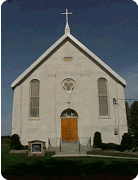
Faithful Choices
FAITHFUL CHOICES
TO
BECOME A HEALTHY CHURCH
Congregational Workbook
for
Small-membership
Rural Churches
Rev. Dr. Donna j. Mann
